
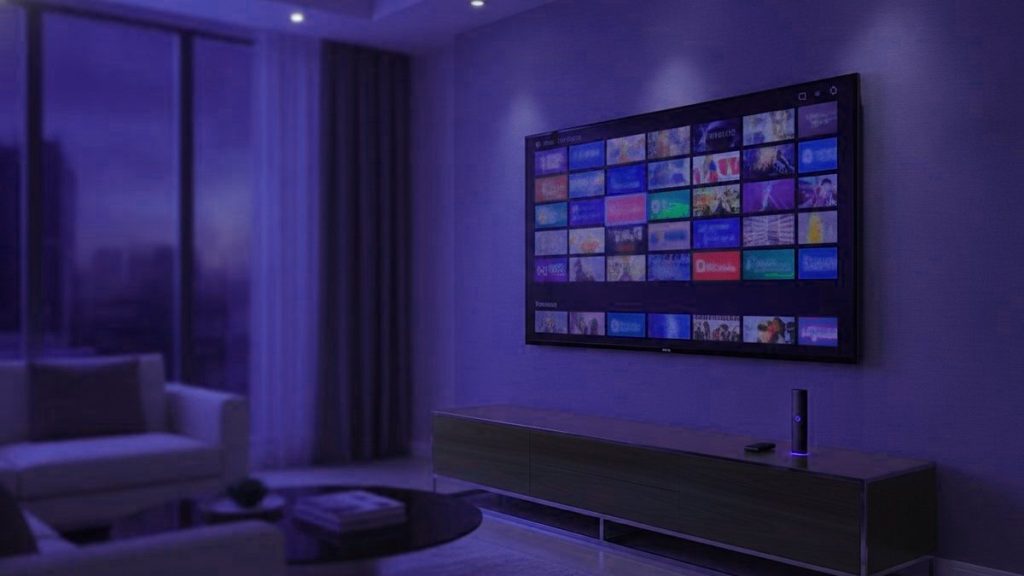
If you have ever pressed play on BBC iPlayer, watched a match on the Sky Sports app or caught up on ITVX, you have already used IPTV. Internet Protocol Television simply means the telly arrives down your broadband line as data, rather than through a rooftop aerial, a satellite dish or a coaxial cable from the street. A subscription IPTV service works on that same principle, only it hands you thousands of live channels and a box-set library through one login instead of a single broadcaster’s app.
The plain version
Freeview and Sky push every channel out to everyone at once, whether anyone is watching or not. IPTV sends the one channel you asked for, to you, the moment you tap it. Nearly everything that feels different about it, good and bad, comes straight from that swap.
You are already halfway there
British and Irish homes have been drifting onto internet telly for years without calling it that. iPlayer, ITVX, Channel 4’s on-demand app, the RTÉ Player, Now, Sky Stream and Sky Glass all carry the picture over your connection rather than an aerial. Sky Stream is the clearest example: it is a Sky subscription with the dish removed entirely and the whole line-up delivered over the internet.
A standalone IPTV subscription takes that idea and widens it. Instead of one broadcaster’s slice, you get a single app pointed at a provider’s servers, and through it live channels from the UK, Ireland and dozens of other countries, plus a large on-demand catalogue. The mechanism is ordinary. What varies wildly from one provider to the next is how well it is run.
What happens the moment you tap a channel
Tap BBC One in the app and your player opens a line to a server. The server starts sending that one channel, sliced into short numbered segments a few seconds each. Your player quietly downloads a handful before it shows you anything, then keeps topping up that small store while you watch and plays from it.
That little store is the buffer, and it explains most of what people grumble about. Kept full, the picture is flawless. If the connection hiccups or the server is heaving under a Saturday-afternoon crowd, the buffer empties faster than it refills, and when it hits zero the picture freezes. That pause is not the channel breaking. It is the player sitting and waiting for data that has not shown up yet.
Why the neighbours get a better picture than you
Two houses on the exact same broadband package can have completely different experiences of the same service, and the broadband is rarely the culprit.
- How crowded each server is. A provider that undercuts everyone has bought thin capacity, and it buckles the instant a big match kicks off. Nothing at your end changed; the queue in front of you got longer.
- Whether a channel has fallback qualities. A feed offered in 4K, HD and SD gives your player somewhere to drop down to when the line dips. A single-quality feed either plays or it does not.
- How far the server sits from you. Data hopping between Britain and a server on another continent has far more chances to be delayed than data staying inside these islands.
- Your line at nine on a Sunday evening, which is a very different number from the headline speed printed on your bill.
This is exactly why a quick try on a Tuesday morning proves nothing. Every service looks faultless with its servers half empty. Test it when the whole country is watching, or you have learned nothing.
Live telly is the whole point, not box sets
People muddle IPTV with Netflix and Disney+, and they are answering different needs.
| Freeview / Sky | Netflix / Disney+ | IPTV | |
|---|---|---|---|
| How it reaches you | Aerial, dish or cable | Broadband | Broadband |
| Live sport | Yes, within your package | Almost none | Yes, across many broadcasters |
| Foreign channels | Very few | Dubbed catalogue only | Channels from 60+ countries |
| Programme guide | Yes | Not applicable | Yes, a familiar grid |
| Box-set library | Limited catch-up | Its whole reason to exist | Yes, alongside live |
Streaming apps replaced the video shop. IPTV is aimed squarely at the household that was keeping an expensive telly package mainly for live football, rugby, racing and news, and wants all of it in one place. The people who move over are usually the ones tired of juggling a Sky bill, a TNT Sports add-on and three streaming subscriptions.
What you need to be watching tonight
A steady broadband line. Roughly 25 Mbps keeps a 4K feed happy and about 10 Mbps is fine for HD. Steadiness matters more than a big headline figure, because the buffer cares about the gaps, not the average. Where the Wi-Fi is weak near the telly, a cheap Ethernet adapter cures more complaints than anything else you could buy.
Something to run the app on. A Fire TV Stick from Amazon, an Android TV box, a Samsung or LG set from 2016 onward, an Apple TV, a laptop, or a MAG or Formuler box. Almost every home already owns at least one.
A player app. IPTV Smarters Pro or TiViMate suit most people. Both arrive completely empty and hold no channels until you type your subscription in, which is the single biggest cause of first-night panic.
The subscription itself. This is the part you pay for and the part that decides whether the whole thing is any good. Everything above it is ordinary hardware and free software.
The handful of words you will meet
An Xtream Codes login is three things: a server address, a username and a password. Most modern players ask for exactly those and sort out the rest themselves. It is the tidier route and the one we hand out by default.
An M3U link is one long web address that carries the same details bundled into it, made for players such as VLC and Kodi that expect a playlist. Guard it like a password, because that is effectively what it is.
The EPG is the programme guide, the grid you scroll to see what is on. Keeping it accurate across tens of thousands of channels is dull, endless work with no glamour to it, which is precisely why a full, current guide tells you a provider is actually maintaining something.
Where it earns its place in a UK or Irish home
The strongest case is sport that no single broadcaster carries. A Premier League weekend now spills across several rights holders; add the EFL, the FA Cup, the Scottish Premiership, the League of Ireland, GAA on a summer Sunday, the Six Nations, racing and the darts, and one login that reaches the lot starts to look sensible. Households with family abroad, or roots in another country, value the channels from 60+ countries that Freeview and Sky simply do not carry. And the 120,000+ on-demand titles mean the box sets sit next to the live telly rather than in yet another separate app.
Is it above board?
The technology is entirely legal and completely mainstream; your phone company almost certainly runs on it. The question worth asking is whether a given provider holds the rights to distribute what it sells, and in this market that is often hard to tell from the outside. Our guide to IPTV and the law in the UK and Ireland works through it honestly rather than waving it away.
How to weigh up any provider, us included
- A free trial, used at a busy hour rather than a quiet one.
- Prices published in the open. Having to message for a quote means you are being priced one person at a time.
- Refund terms written down, with a stated number of days.
- Support that replies before you have paid. It never gets keener afterwards.
- A proper website. A seller who exists only inside a messaging account can vanish overnight, and plenty do.
Ours are laid out on the pricing page and the trial page, and you should hold us to the same test as anyone else. Once you have a login, the setup guides walk through each device, and getting from payment to your first channel usually takes under a quarter of an hour.
Frequently asked questions
How does IPTV work, in plain terms?
A provider gathers TV channels, turns each one into an internet-sized video stream and keeps them on its servers. Your player app signs in with a server address, username and password, asks for a channel, and the server sends that one channel to your device alone. It behaves like pressing play on iPlayer, only applied to thousands of live channels at once.
Is IPTV the same as Netflix or Sky Stream?
Underneath, all three send telly over your broadband. The difference is that Netflix is a closed app with its own licensed catalogue, and Sky Stream is a Sky subscription with the dish removed. An IPTV subscription is an open Xtream login that works in any compatible player and leans towards live channels rather than box sets. Netflix itself is never bundled into an IPTV plan.
Do I need a box to use IPTV?
No. Anything that runs a player app will do: a Fire TV Stick, an Android TV device, a Samsung or LG smart telly, an Apple TV, an iPhone or Android phone, a Windows PC or a Mac. Dedicated boxes such as Formuler and MAG are optional and mainly hand you a nicer remote and a quicker guide.
What broadband speed do I need?
Roughly 10 Mbps keeps one HD stream steady and about 25 Mbps handles a 4K stream. For two tellies at once, aim for around 30 Mbps. Steadiness matters more than the headline figure on your bill, and running an Ethernet cable to the telly clears up most of the buffering that Wi-Fi causes in the evening.
Why do free IPTV playlists stop working?
A free M3U list is a single account shared with thousands of strangers. The server either blocks it or simply cannot serve everyone, so channels die within days and the survivors freeze the moment anything popular is on. A paid subscription is a private account on servers sized for peak hours, which is the whole thing you are paying for.
Is IPTV legal in the UK?
The technology is legal everywhere, and mainstream services such as iPlayer and Sky Stream are built on it. What matters is whether a provider holds the rights to the channels it carries, which varies. In the UK and Ireland enforcement targets operators and sellers, and courts order broadband providers to block servers during live sport. Our legality guide works through it properly.
Fancy your own login to 25,000+ channels?
Message us on WhatsApp and you are watching in under 15 minutes, with a 7-day money-back guarantee if it is not for you.
Related articles
Best IPTV Box for 2026: What to Plug Into Your Telly
Most people do not need an IPTV box; a $40 Fire TV Stick beats a $180 unit for nearly everyone. Devices weighed…
4 September 2026Best IPTV Player Apps for 2026: The Right One for Each Device
No IPTV app suits everyone; the right one depends entirely on the device under your telly. TiViMate, IPTV Smarters Pro, Smart IPTV,…
2 September 2026How Much Does IPTV Cost in the UK? Real Prices in Dollars
IPTV costs about $15 a month or $69 a year on one device, roughly $5.75 a month. Our real prices in dollars,…